Friday, January 1, 2021

Natural Dyeing - New Beginnings

I continue to do lots of experiments with natural dyeing. The series described below were all done on single ply 50/50 wool/mohair yarn that I got as part of a swap a few years ago. This is a fairly coarse yarn that would do very nicely for a rug, or outerware. These dyestuffs were all ones that I had either gathered locally or saved from years before. The first set of skeins were pre-mordanted with alum, copper and iron, respectively and dyed with avocado peels that I had frozen over a year before for a friend for use in a dyeing class that was later cancelled. I had never used peels before, and found the grayish greens to be quite a pretty surprise. The mordant does make a difference in the color produced, but it is subtile.
The next set of skeins were again pre-mordanted with alum, copper and iron, respectively and dyed with fresh goldenrod. The top row of skeins was dyed with golden rod leaves and the bottom row with flowers. I really liked the colors produced and use of leaves vs. flowers and type of mordant really makes a difference.
I've often wondered if stored dried dyestuffs lose potency over time. These two skeins were mordanted with alum and copper and dyed with marigold flowers that I had grown and dried about 15 years prior, so at least for dried marigolds (stored at room temperature in dark), they do retain their potency.
The next single skein was mordanted with alum and dyed with privet. Chinese privet is considered a non-native invasive plant, and a friend was very happy to have me wack down her privet. I read somewhere that privet (type not specified) could be used to obtain green so it was a bit disappointing to get tan instead. This was also a dyestuff that had been dried and stored for about 6 years.
The final set of skeins were dyed with green walnut hulls that I gathered in the yard two years ago, and allowed to get mushy in a bucket in the basement. I used no mordant for one skein in this case because walnut is a substantive dye, meaning there are enough tannins in it to act as a mordant, and then also used alum mordant for a second skein just to see what difference it made. I really like the more golden brown of the first skein. The third skein is dyed with no mordant, but using the same dyepot a second time. The paler shade tells me that the dye bath was losing potency in this case.

Monday, October 10, 2016

Dyeing with Alkanet

This was a new venture for me, never having dyed with alkanet in the past. Based on my reading, it is a relatively weak dye plant, requiring ~75-100% weight of goods; this means that if for example, you want to dye 8 oz of fiber then you need 6-8 oz of the dried plant to start out. Another interesting challenge with alkanet is that the pigments are not water soluble; the sources I consulted recommended extracting it into alcohol. I started with 4 oz of alkanet, placed in a quart jar and soaked in denatured alcohol for 4 days prior to using it. I strained off the dye liquid using an old wire mesh strainer, and added it to the warm water in the dyepot. The two skeins below and the first and second dye baths respectively. The yarn is a 50/50 wool/mohair blend the was pre-mordanted with alum/cream of tartar. Time in the pot for both the first and second baths was ~ 30 minutes, and the skeins in the second bath were allowed to cool overnight in the pot and washed the next day.

Sunday, April 10, 2016

Osage Orange with Multiple Mordants

April's group dye pot was Osage Orange. In this case I was using sawdust, contained in an old nylon stocking which soaked in the dye pot for 24 hours followed by heating to close to boiling for about an hour prior to yarn being added. Below are some small sample skeins showing the different effects possible with various pre-mordants.

Friday, March 11, 2016

Dyeing with Madder

Madder is one of those dyes that is supposed to give red, but in my experience, not very often. After reading some books and watching a few videos, I learned that if chopped madder root is soaked, and the water discarded then it supposedly gives better reds because it removes more tannins that are concentrated in the bark of the root, and in addition, adding calcium carbonate (chalk) is also supposed to give better reds, especially if done after the madder has been chopped during heating. So I started with dried chopped madder root.
I soaked about 5 oz of madder root in water with no heating for 24 hours and poured off and kept the liquid. I did this twice and then chopped the madder in fresh water using an old blender. The chopped madder went into a stocking and then was brought slowly to boiling over a period of about 2 hours. I also used the soak water from before the madder was chopped to dye a skein of wool yarn that had been pre-mordanted with alum, which is on the far left in the picture below. The other skeins in order were pre-mordanted with alum, copper and iron. Ironically, the reddest skein is the one that was dyed in the soak water before the madder was chopped.

Wednesday, January 20, 2016

More Over-Dyeing - The Logwood Makeover

More skeins that are rather bright, and in some cases a little mottled from bleeding during rinsing from JB. These were re-mordanted with alum and then rinsed well.
When I brought them home there was indeed no washout of color when wetting them down for the dyepot. The dyepot is leftover logwood from the last dye day. This pot (started from 4 oz log wood) has already dyed almost 2 lbs of fiber. Since there was clearly life left in the pot, I added these skeins (about 1 lb total), plus a small one of my own to see what I would get with a white skein. Pre-wetted warmed skeins went into the pre-warmed dye bath and simmered low and slow for about 30 minutes and then cooled in the pot for about 3 hours. The results below are stunning. The rather bright colors are nicely muted and the mottled skeins are showing only slight variegation. My white skein came out a medium purple.

Friday, January 8, 2016

Over Dyeing in Logwood

Transformations can be so magical. Two shots below of a scarf pre- and post-overdyeing with logwood. Below that is gray-green produced by over-dyeing skein originally dyed with yellow onion with logwood. The rule of thumb I've developed over the years is that if you don't like the color, overdyeing in blue will make it better.

Friday, January 1, 2016

Over-dye in Reverse - Indigo & Yellow Onion

In the usual way of things, if you want green from natural dyes and are using indigo, typically you dye with the plant material that will give yellow followed by over-dyeing with indigo. The reason being that indigo tends to be a very strong dye and it is easier to control color and depth of shade by using multiple dips of indigo until you have the green you want. In this case the yarn had been dyed with indigo by a fiber friend who told me it was crocking badly and wondered if I could try dyeing it with the leftover yellow onion dye bath from one of my on farm dye days. Thinking this would be a fun experiment, I readily agreed. My first step was to wash out the excess indigo using synthrapol - it took a lot of rinsing, but eventually the rinse water was much lighter. I then gave the skein a bath in 20/80 white vinegar/water which yielded a clean rinse. The next step was to heat up the leftover dye bath and also add back in the fine mesh bag containing the onion (removing the bag of wet plant material and allowing it to dry prevents mold). The yarn was simmered for 30 minutes and allowed to cool down in the dye pot overnight prior to final rinsing. The two pictures below show before and after - definite darkish green with blues. The small skein in the lower second picture is one that I simmered after the indigo skein had been removed; the purpose was to see if I could still get yellow out of the dye pot, which clearly was the case. The great thing about this kind of experiment is that the yarn goes back to the original owner and I don't have yet another dye experiment skein for which I don't have a purpose.
Saturday, November 21, 2015

Brazilwood Dyeing

This was the first time I've used Brazilwood in quite some time and certainly the first time with this much variation in preparation and handling the pot. First I soaked the Brazilwood sawdust (3 oz) overnight in a nylon stocking to contain the chips/sawdust; then I boiled it for 1 hour. Then I added pickling lime, i.e. calcium hydroxide (about 1/2 oz), plus a stick of ground up chalk to a pot of hot water, and then the dye liquor and bag of chips. The pH at this point was close to 9.0. A mix of fibers was added (mostly wool), some of which had been pre-mordanted with alum or copper. Then the bath sat for about a month prior to being acidified with citric acid; interestingly I had no problems with mold growing in the pot during the month it sat idle. I did take the precaution of removing the bag of Brazilwood chips and letting it dry out after we had finished with the first basic pot, and then put it back in the pot just prior to acidifying the pot. The pH just prior to acidifying the pot was about neutral and after the addition of citric acid (~2 oz) it went to about pH 5. Below is a picture of the resulting wool yarns. From left to right, it is alum and copper pre-mordant with basic 1st pot, then alum and copper pre-mordant in the acidified 2nd pot. The two things that are most striking to me are the range of color and that their is very little apparent difference between the alum and copper pre-mordant yarns.

Friday, January 30, 2015

Frogging Happy

I truly love bulky yarn and have had a wonderful time dyeing and then knitting and crocheting two projects out of some super bulky yarn that I purchased from Heelside Farms in Four Oaks, NC. The first project was my second knitted hat in the Collapsible Cloche pattern which can be seen on my Ravelry projects page. This was supposed to be for me and ended up being for Gary because it fits and is convenient to grab and wear on cold winter mornings out taking care of critters. Since I had plenty of yarn left for another hat this seemed like it would work out just fine. Having decided I wanted a crocheted tam, I found a pattern that seemed ideal - Super Bulky Tam by Candice Veazey. The only thing I didn't reckon on was that the size of yarn differed somewhat from the pattern which I faithfully followed to produce the first tam pictured.
After three different people remarked that I would really need dreadlocks to look my best in this hat. I decided that I had to reduce its size - which of course meant that I had to pull out some of what I had done (5 rows in fact) and then redo the brim. After a bit of help finding my ends and carefully pulling out the 5 unneeded rows, I was able to redo the brim/band to produce a much better sized hat. I'm usually pretty resistant to pulling out what I've done so this is a step forward.

Sunday, April 27, 2014

Hat & Scarf Combo

This will be the year of hats on circular needles. This one was started on straight needles, transferred to circulars and then finally finished on double point needles. The pattern is called "Collapsible Cloche" and I found it at the back of a novel. The yarn is WoolEase and I got it at the annual February Fiber Swap and Bring a Friend month event at Hot Wheels Handspinning Guild. This pattern is actually intended to be felted and shrunk somewhat, but WoolEase is only 30% wool so it didn't felt or shrink as I had hoped. The hat still came out looking quite nice, especially with the matching scarf. This is another one that is destined for donation to one of the local groups that gathers warm winter wearables.

Tuesday, February 11, 2014

Scarf Irony

I am awash in yarn. One might even call me "yarn-rich" - how's that for a cool new word. What it means is that I am well stocked with yarns for every conceivable purpose, fiber and source - from handspun luxury to mill spun from the fibers of my own critters to a few stray skeins of bulky synthetic for knitting charity hats and scarves. So why would I ever go out and buy yarn? The answer is simple - because I wanted it and this is certainly not a yarn I can imagine producing via hand spinning. The yarn is called Flick-Flak and it came from Twisted Knitter in Mebane, NC. It is one of those new (at least to me) novelty yarns, and I'm enjoying it quite a bit. So far I've knit two scarves - one I call the summer scarf (pictured left)
and the other one I call the autumn scarf (pictured right)
. These were Christmas gifts for my mom and SIL. I'm hoping to start a new one in a different yarn called Tricor that will be for me.

Monday, January 13, 2014

Multi-Strand Knitted Scarf

This is my latest way to diversify my knitting without the necessity of doing things like following a pattern or learning new stitches. The scarf pictured was knit with a total of 4 strands of yarn on size 17 needles: 3 strands of handspun (medium blue, dark blue and natural black Shetland wool) plus a strand of Sari silk yarn. I really like the look of Sari silk yarn, which is hard to work with by itself (perhaps the lack of elasticity). However if combined with wool in multi-strand knitting, it really looks pretty and is much easier to manage.

Saturday, July 27, 2013

Dyeing with Mushrooms - motivational fungi

Okay, so given the unexciting results of my previous attempts at dyeing with mushrooms - various shades of tan, why would I do it again? The answer is of course - a truly stunning and beautiful mushroom like the one pictured below. I've never seen one like this so just had to try it.
I followed the same procedure outlined in previous posts. The results were pretty much the same as before - more tan wool. I think I am headed back to my indigo pots.

Tuesday, December 25, 2012

What A Difference A Dye Makes

This is a tale of 5 skeins of 90/10 mohair/wool yarn that were dyed in a varigated colorway that no one seemed to want to buy. To be honest, I did not like it much either. Pale red and bright yellow blending into oranges, just really are not my colors.
I was debating whether to simply offer these skeins up at our guild Christmas swap, when a friend suggested that I over-dye them. We debated on colors and I ended up going with a bright turquoise (Jacquard).
And Wow! - what a difference. I may even keep these for me if I can find a pattern that suits them.

Friday, October 5, 2012

Dyeing with mushrooms ... first fruits

To start the process, I just emptied the gallon jug with the mushroom liquid into the dyepot, added another gallon of water, heated it up and added some wool roving, a skein of yarn and some cotton. Nothing seemed to be happening in terms of color strike and it smelled strongly of ammonia. Remembering that one usually dyes protein fibers with acid dye and ignoring the fact that I had stuck some cotton in there as well, I acidified the bath with vinegar until I couldn't smell the ammonia any longer - not precise, but it seemed to work because the fiber and yarn did visibly begin to take up color. I kept the temperature of the bath below boiling, but steaming and let it stay heated for about 45 minutes. Then I let it cool in the pot overnight and rinsed and washed it out the next day. The color is a light tan.

Saturday, September 22, 2012

Dyeing with Mushrooms ... the saga begins

I had never considered this idea until one of the ladies at a 2nd Saturday spinning meeting and dye party mentioned that one of our mutual friends said you could extract some kind of color from virtually any mushroom. There are lots of mushrooms popping up all over the place so I decided to give it a try. I'm using gallon plastic jugs (that used to contain vinegar) that I fill about 1/4 full with mushrooms and then add a mixture of 3 parts water to 1 part household ammonia. I am on my 3rd jug at this point (set one last week, another this Friday and one today) and the pattern has been the same with all three. First the liquid starts out translucent tan in color and is very dark within a few hours. This is what is shown in the pictures below. I can literally see the liquid turning darker as something is extracted out of the mushrooms; I am hoping that it is color. Tomorrow I hope to dye with the one that has been sitting for about a week. Stay tuned for developments...

Sunday, September 16, 2012

Hooded Scarf

This is a hooded scarf I finished last March knitted on size 13 straight needles. The yarn is a bulky merino superwash (Viking Balder) that came from The Twisted Knitter in downtown Mebane. This yarn is wonderfully soft and fun to knit.

Sunday, September 9, 2012

The Hat I Will Never Wear

Sometimes there are things you make just because you can - wearables that you will never wear
, unplanned flights of fantasy of unknown origin. I completed this knitted hat,tassels and all, last winter while waiting for the radiator on the truck to be repaired. The yarn is a bulky wool blend feels very soft. It looks almost cute on the manniquin head, which has turned out to be a very handy item.

Sunday, September 2, 2012

Dyeing Angora Rabbit Fiber with Indigo

This is the story of a pot of indigo ("instant" variety) that was left to sit for a couple of weeks. Since it looked regenerated (metallic sheen on the surface). I decided to see if I could dye some angora. At first things didn't look too hopeful.
But then once out of the pot and sitting on a screen, color began to develop.
The final blue looks quite nice and once dry it was a lovely shade of denim blue, no crocking and it feels soft and nice.

Tuesday, September 27, 2011

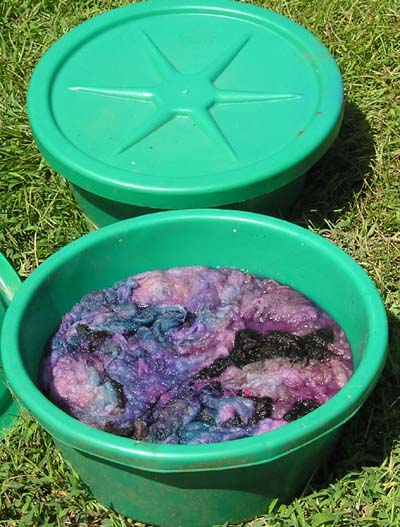
Low Input Washing & Dyeing of Wool - Part II


The second phase of the low input washing and dyeing experiment began with filling two old feed supplement tubs with water from the cistern system, putting in a generous two cups of vinegar and letting it warm up in the sun of a 90 plus degree day. I added the fleece (single fleece split in half), springled the dye on top (Cushings myrtle green and Cushings violet) and let it sit a minute. Then I mixed dye and wool by massaging them together with my hands (wearing gloves and mask because of the dye in powdered form). The point of this was to make the dyes color split to produce more interesting effects. The picture shows the fleeces in the dye pots after having been mixed together. I put the lids on and left it for 3 days. When I opened them up the dye bath was exhausted (no color left in the water). One rinse with warm water from the cistern and spinning out in the washer tub, resulted in minimal to no excess dye coming off (a very good sign). Now it is just time to let it dry and see how it spins up in the next phase.